- Hashed Out
- Posts
- Web3 for Families
Web3 for Families
What Happens When Work Gets Borderless, Permissionless, and Tokenized?

Scott Kasten
March 20, 2026
Money, games, education, and digital property in everyday life
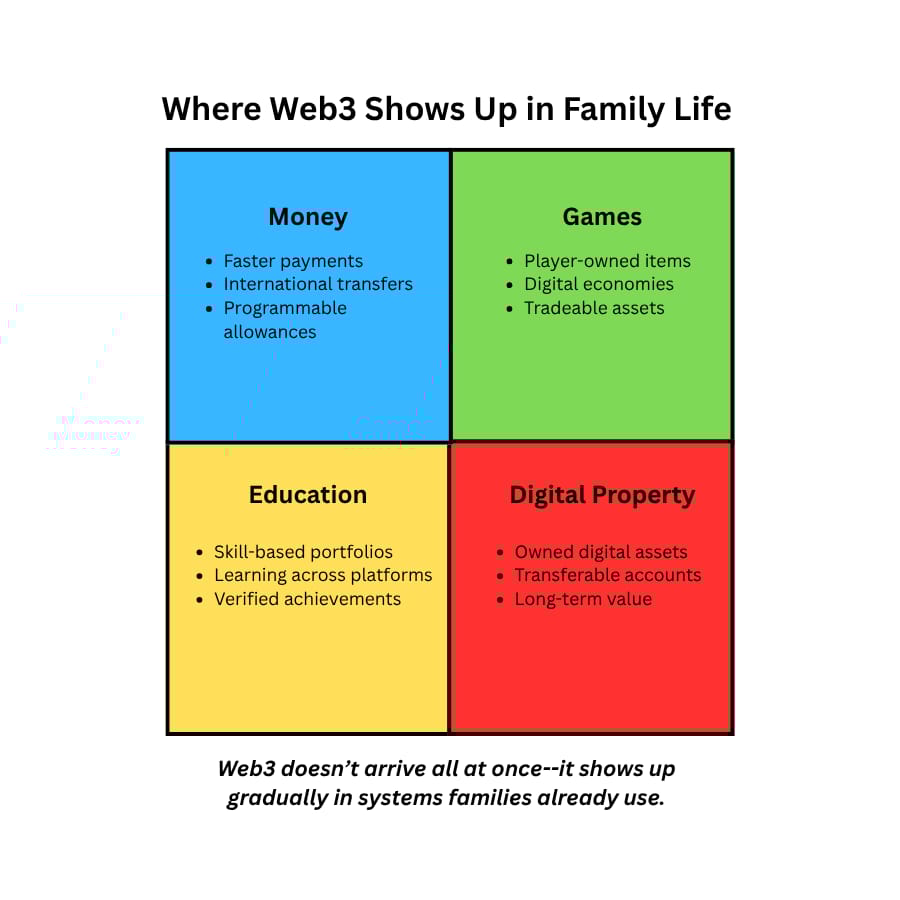
When Web3 is discussed, it’s often framed in terms of markets or technology. But for most people, its impact—if it comes—will show up in much more familiar places: how families manage money, how children play games, how learning is structured, and how digital assets are owned.
These changes are not happening all at once. In many cases, they are subtle extensions of systems that already exist. But taken together, they point toward a shift in how digital life is organized.
For families, the question isn’t whether to “adopt Web3.” It’s how these ideas may gradually shape the environments their children are already part of.
Digital Money and Family Finance
Most families today use a mix of bank accounts, credit cards, and payment apps. Money moves, but often with friction—especially across borders or between systems.
Web3 introduces the idea of programmable and portable digital money.
That may sound abstract, but it can show up in simple ways.
For example:
• A parent sending money to a child studying abroad could do so instantly, without international transfer fees or delays.
• An allowance could be structured digitally so that a portion is saved automatically and a portion is spendable.
• Payments for chores or small jobs could be tied to simple conditions (“complete this task, and payment is released”).
These ideas already exist in early forms through digital wallets and stablecoin systems, even if most families don’t think of them as “Web3.”
The broader shift is that money becomes more flexible and programmable, not just something stored in an account.
Games and Digital Ownership
If you want to see where Web3 concepts are most visible today, look at how children interact with games.
Many popular games already include:
• digital currencies
• purchasable items (skins, characters, upgrades)
• virtual economies
But there’s an important limitation: these items are controlled by the game company. Players don’t truly own them.
If the game shuts down, the items disappear.
Web3 introduces a different model: player-owned digital assets.
In this model:
• a player could own a digital item independently of the game
• items could potentially be traded or sold
• assets might move between compatible platforms
A simple example:
Instead of buying a skin that only exists inside one game, a player might own an item that can be used, traded, or sold outside that game environment.
This model is still evolving—and not all implementations have worked well—but it introduces a new idea for families to consider:
Digital items can have real ownership characteristics, not just temporary access.
Education and New Forms of Learning
Education is where Web3 may have one of its most interesting long-term impacts—not just in credentials, but in how learning happens.
Today, learning is largely structured through institutions:
• schools
• universities
• formal programs
Progress is measured through grades, transcripts, and standardized systems.
Web3 opens the possibility for more modular, flexible, and verifiable learning experiences.
For example:
Learning Across Platforms
A student might:
• take a course from one provider
• complete a project in another environment
• contribute to an online community
• build a portfolio of verified work
Instead of learning being tied to a single institution, it becomes a collection of experiences.
Learning by Doing
In some Web3-based communities (such as DAOs or open-source ecosystems), learning happens through participation.
A teenager interested in design, coding, or writing could:
• contribute to a real project
• receive feedback from a global community
• build a track record of completed work
This resembles an apprenticeship model, but in a digital environment.
Verified Skill Development
Instead of relying only on grades, systems could verify:
• completed projects
• demonstrated skills
• contributions to real work
For families, this raises an important shift:
Learning may become less about where you studied and more about what you can demonstrate you’ve done.
Digital Property and Ownership
Families already manage digital assets, whether they think of them that way or not:
• photos
• music and media
• in-game purchases
• subscriptions
• online accounts
But ownership is often limited. Many digital assets are tied to platforms, meaning:
• you don’t fully control them
• they can’t be transferred easily
• access can be revoked
Web3 introduces the idea of true digital property—assets that are:
• owned by the user
• transferable
• not locked into a single platform
A practical example:
A family might eventually hold digital assets—whether financial, creative, or functional—in a way that allows them to:
• transfer them between accounts
• pass them on to children
• manage them alongside traditional assets
This doesn’t mean everything becomes tokenized, but it does suggest that digital ownership may start to resemble real-world ownership more closely.
5️⃣ Identity and Growing Up Online
Children today begin building a digital presence early in life.
That presence is currently fragmented across platforms:
• school systems
• social media
• gaming accounts
• learning platforms
Each system creates its own version of identity.
Web3 identity models explore a different approach: a portable, user-controlled identity layer.
In this model:
• identity is not tied to a single platform
• credentials can be attached to identity
• individuals control what information they share
For families, this could eventually change how children:
• build online reputations
• transition between platforms
• manage privacy and identity
Instead of rebuilding identity on each new platform, identity becomes something that travels with the individual.
Why This Matters for Families
Most of these changes will not arrive as a single “Web3 moment.”
They will appear gradually:
• a new type of payment option
• a different kind of game economy
• a new way to document learning
• a new approach to managing digital assets
For parents, the value in understanding these shifts is not technical—it’s practical.
It allows you to:
• recognize what is actually changing
• guide children through new digital environments
• distinguish between meaningful developments and hype
Final Thought
Web3 is often discussed as a technological shift, but for families, it may be experienced as a series of small changes in everyday systems.
Money becomes more flexible.
Games begin to blur with ownership.
Learning becomes more portable.
Digital assets become more tangible.
Individually, each change may seem minor.
Together, they suggest that the digital environments families rely on today may gradually begin to work a little differently tomorrow.
Stay ahead of the curve with the latest in Web3 culture and innovation. Subscribe to Hashed Out for exclusive insights, case studies, and deep dives into the decentralized future.
Help Grow Hashed Out And Get Rewarded With Premium Content & Merchandise
If you believe in a more open, fair internet — help us build it, one reader at a time.
Web3 adoption starts with curiosity. Share Hashed Out with someone who’s ready to explore.
You’re not just sharing a newsletter — you’re inviting someone into the future of digital life.
Refer 3 friends and unlock premium content. The more you share the more rewards you unlock, including Hashed Out mugs or tote bags, and exclusive community memberships.
Other Articles In This Issue: