- Hashed Out
- Posts
- Should Kids Have a Crypto Wallet?
Should Kids Have a Crypto Wallet?
A question about technology, responsibility, and how kids learn about money

Scott Kasten
March 27, 2026
When most of us learned about money, the process was gradual.
It started with cash—allowances, small purchases, maybe a savings jar. Over time, that expanded into bank accounts, debit cards, and eventually credit. Each step introduced new concepts: saving, spending, responsibility, and consequences.
The system was structured, and importantly, it was forgiving. Mistakes could often be corrected. Banks could reverse transactions. Parents could intervene.
Crypto wallets introduce a very different model.
They raise a simple but important question
Should children learn about money through systems that are less forgiving—but potentially more reflective of where digital finance is heading?
The Technical Answer vs. The Practical Reality
At a technical level, anyone can create a crypto wallet. It’s simply a piece of software—there’s no built-in age restriction.
But in practice, things work differently.
Most platforms where people buy, sell, or convert crypto require users to be at least 18 and to verify their identity. That means minors typically cannot access the full financial system on their own.
So in real-world terms, when kids use crypto wallets today, it usually happens under parental control:
• a parent sets up and manages the wallet
• small amounts are introduced
• usage is supervised
This makes crypto wallets less like independent financial accounts and more like tools that families can choose to introduce intentionally.
What Makes Crypto Wallets Different From Bank Accounts
To understand the decision, it helps to understand what makes crypto wallets fundamentally different.
Traditional financial tools are built around intermediaries:
• banks can reverse transactions
• fraud protections exist
• customer support can resolve mistakes
Crypto wallets operate differently.
They are based on self-custody, meaning:
• you control the assets directly
• transactions are typically irreversible
• there is no central authority to correct errors
In practical terms, this means:
Sending money to the wrong address doesn’t result in a customer service call—it results in a permanent loss.
That level of responsibility is not something most children (or adults) are used to.
But it is also closer to a model of true ownership, where control and responsibility are directly linked.
The Educational Opportunity
For some families, this is exactly the point.
Crypto wallets can introduce financial concepts in a very direct way:
• the difference between access and ownership
• the importance of security
• the permanence of transactions
• the idea that digital assets can have real value
A small, supervised wallet—funded with a modest allowance—can become a learning environment.
For example:
A child who manages a small amount of digital money may learn quickly that:
• safeguarding access matters
• decisions have consequences
• transactions are not easily undone
In this sense, crypto wallets can function less as financial tools and more as experiential learning environments.
And as digital systems become more integrated into everyday life, that type of learning may become increasingly relevant.
The Risks and Tradeoffs
At the same time, the risks are real—and they are different from traditional financial systems.
Crypto wallets introduce challenges that many families may not be comfortable with:
• no recovery if access is lost
• exposure to scams or phishing attempts
• complexity in managing keys and security
• potential exposure to volatile assets
A simple mistake—sending funds to the wrong address or clicking on a malicious link—can result in a permanent loss.
Unlike a bank account, there is no safety net.
For children, this raises an important question:
Is this the right environment for early financial learning, or does it introduce unnecessary risk?
The answer will vary depending on the child, the level of supervision, and the goals of the family.
A Better Way to Think About It
Framed as a yes-or-no question—Should kids have a crypto wallet?—this topic can feel polarizing.
But a more useful question is:
When and how should children be introduced to financial responsibility in increasingly digital systems?
Crypto wallets are one possible tool—but they are not the only one.
Some families may prefer to:
• start with traditional banking apps
• introduce digital payments first
• build financial habits gradually
Others may choose to introduce crypto concepts early, but in a controlled and educational context.
What matters most is not the tool itself, but the structure around it.
The Bigger Shift
Underlying this entire discussion is a broader change that extends beyond crypto wallets.
Children today are growing up in a world where:
• digital assets have value
• online environments include real economies
• money moves across borders instantly
• ownership increasingly includes digital forms
Even without crypto, kids already encounter versions of this through:
• in-game currencies
• digital purchases
• online marketplaces
• creator platforms
Web3 doesn’t create these trends—it extends them.
It introduces systems where:
• ownership may become more direct
• identity may become more portable
• financial tools may become more programmable
In that context, the question is not whether children will encounter these ideas.
It’s how—and when—they will learn to navigate them.
Practical Approaches for Families
For families thinking about this question, there is no single correct answer. But there are practical ways to approach it.
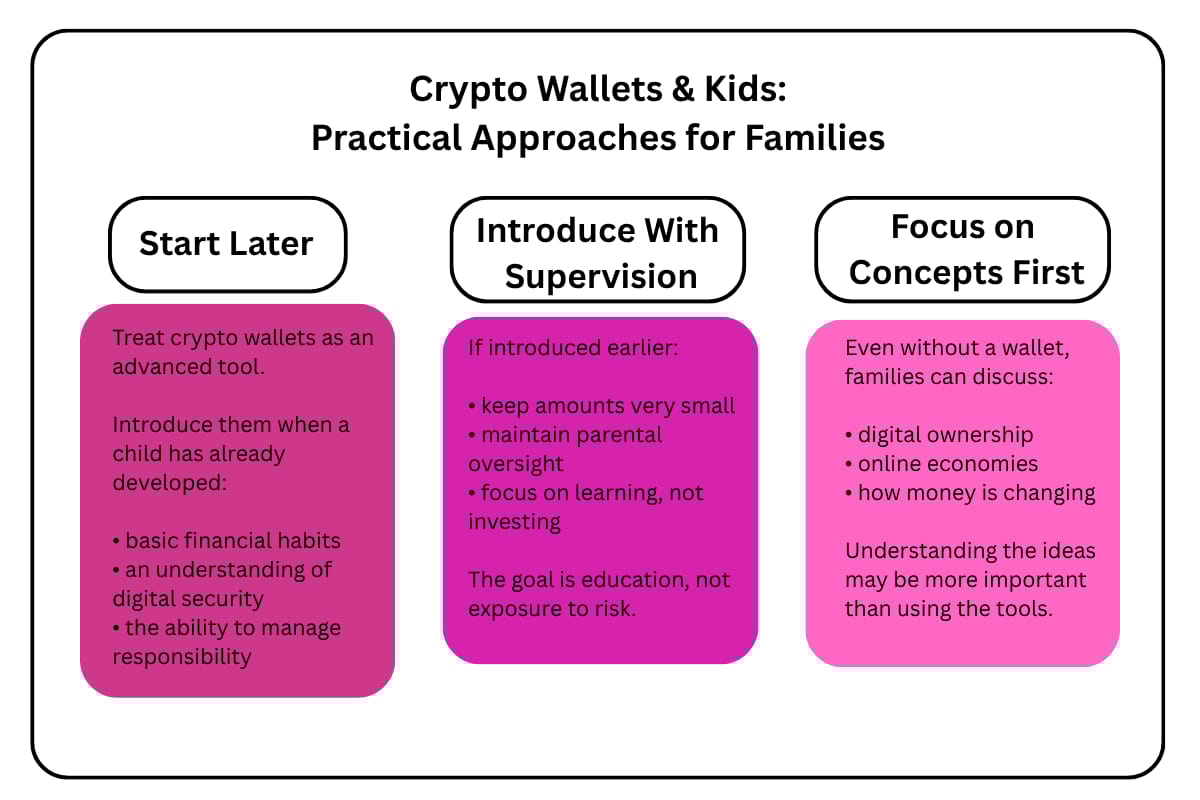
Crypto Wallets and kids
Final Thought
Crypto wallets are not just financial tools—they represent a different model of ownership and responsibility.
For children, they can offer a glimpse into how digital systems may evolve. But they also introduce a level of responsibility that may not be appropriate for every stage of development.
The question, ultimately, isn’t whether kids should have crypto wallets today.
It’s whether they should begin to understand the systems that may shape how money, ownership, and digital life work in the future.
And for many families, that learning may start long before any wallet is involved.
Resources For Parents Wanting to Take the Next Step
For those parents who want to prepare their kids for the digital financial future but also want help with some key tips and access to platforms they can use we have a companion guide in this issue:
It has 5 tips or considerations for before you begin and list of available platforms to use once you start.
Stay ahead of the curve with the latest in Web3 culture and innovation. Subscribe to Hashed Out for exclusive insights, case studies, and deep dives into the decentralized future.
Help Grow Hashed Out And Get Rewarded With Premium Content & Merchandise
If you believe in a more open, fair internet — help us build it, one reader at a time.
Web3 adoption starts with curiosity. Share Hashed Out with someone who’s ready to explore.
You’re not just sharing a newsletter — you’re inviting someone into the future of digital life.
Refer 3 friends and unlock premium content. The more you share the more rewards you unlock, including Hashed Out mugs or tote bags, and exclusive community memberships.