- Hashed Out
- Posts
- Digital Property in 2026: What You Already Own — and How You Protect It
Digital Property in 2026: What You Already Own — and How You Protect It
Ownership, control, and security in a Web3 world

Scott Kasten
January 30, 2026

Editor’s Note
For much of the internet’s history, ownership was something we quietly gave up.
We gained convenience instead. Streaming instead of buying. Accounts instead of assets. Access instead of control. And for a long time, that tradeoff felt reasonable—even invisible. Really, there wasn’t even a choice to be made.
What’s changed is not that digital property suddenly appeared, but that people are starting to notice how much of their digital life already functions like property, even when it isn’t treated that way. Tickets, memberships, digital items, credentials, creative work—these things increasingly behave like things we “own,” yet remain governed by rules we don’t control.
Web3 didn’t invent digital property. It reopens a question most of us stopped asking:
What does it actually mean to own something online?
This issue looks at that question from two sides. First, what digital ownership really means today—and where it already shows up in everyday life. Second, the less comfortable but unavoidable companion question: how ownership changes responsibility, especially when it comes to security.
Ownership without control isn’t ownership at all.
But control without understanding carries its own risks.
Why Digital Ownership Is Back in the Conversation
For years, the dominant model of the internet favored access over ownership.
You didn’t own your music—you streamed it.
You didn’t own your games—you licensed them.
You didn’t own your online identity—you maintained an account.
That model worked well at scale, but it also created a quiet imbalance. Platforms controlled the terms. Assets could be revoked. Access could disappear.
Digital ownership re-enters the picture not as a rejection of convenience, but as a response to its limits. When people talk about “owning” things online today, they’re often reacting to moments when access vanished, rules changed, or value became trapped.
Web3 doesn’t promise that ownership is always better. It simply makes ownership possible again—and makes the tradeoffs visible.
What Digital Property Actually Means
Digital property is often misunderstood because it’s associated with narrow examples—art, collectibles, or speculation. In practice, it’s much broader and far more ordinary.
Digital property refers to assets that exist digitally but are owned independently of a platform.
That can include:
Tickets and memberships
In-game items or virtual goods
Digital credentials or access rights
Creative work
Financial assets
The defining feature isn’t what the asset is—it’s portability.
If you can move it, transfer it, or retain it without permission from a single company, it starts to behave like property rather than a license.
A useful mental test is simple:
If the platform disappears, does the asset disappear with it?
When the answer is no, ownership begins to matter.
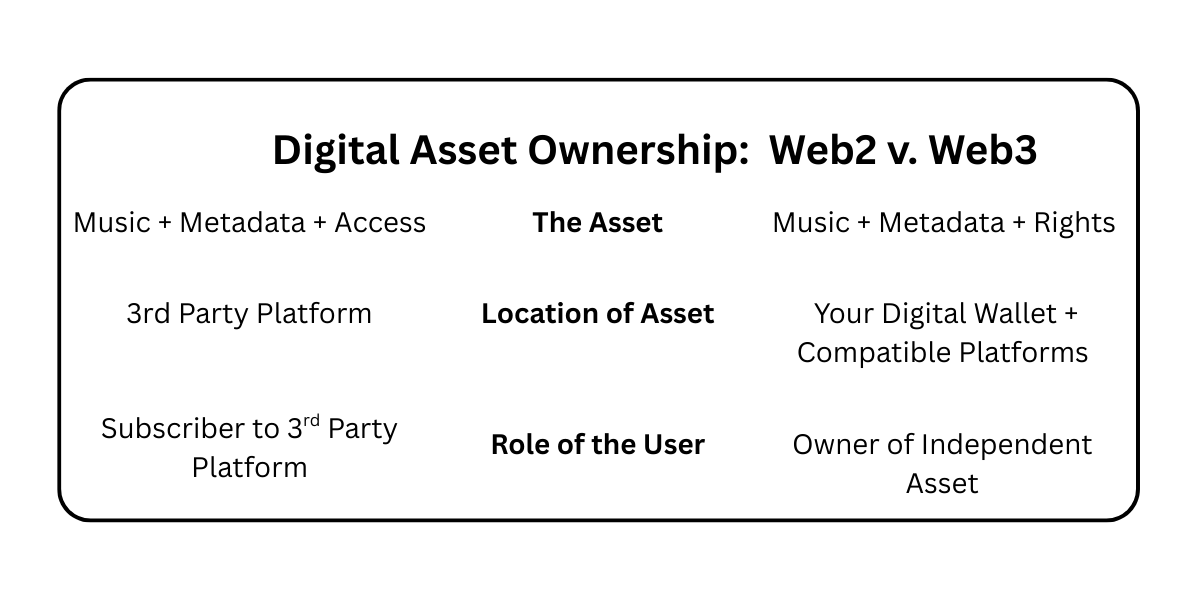
Example: Digital Music Ownership & Control
Where Control Breaks Down Today
For most people, the question of digital ownership becomes real not in theory, but in hindsight—when something they’ve spent years building suddenly feels fragile.
Accounts get suspended.
Libraries disappear.
Access changes.
Terms are rewritten.
For me, that realization often comes back to music.
I’ve spent years curating playlists on Spotify. Around 1,000 songs. Carefully built collections tied to specific moments, moods, and phases of life. It feels like a personal music library. But when you step back, it becomes clear what it actually is.
I don’t own that music.
I don’t own the playlists as assets.
I don’t control long-term access.
If Spotify loses licensing rights, songs disappear. If the platform changes its model, my experience changes with it. And if Spotify were to shut down entirely, years of accumulated curation could vanish overnight. Even if playlists can sometimes be exported, what’s being moved are references—not ownership.
I didn’t build a music collection.
I built a relationship with a platform.
Once you see that distinction, it becomes hard not to notice how common it is.
The same dynamic shows up across digital life:
Photos stored on social platforms or cloud services feel permanent—until accounts are suspended, policies change, or compression and deletion quietly alter what you thought you were preserving.
Social and professional identities built on Facebook, Instagram, or LinkedIn accumulate real value over time, yet remain fully dependent on continued permission from the platform that hosts them.
Games and digital items, especially for younger users, are treated as possessions, even though they disappear the moment a game shuts down or an account is lost.
Tickets and memberships arrive as emails or PDFs, transferable only within tightly controlled systems, vulnerable to revocation, fraud, or platform failure.
None of this requires bad intent. It’s simply how platform-centric systems work. Assets live inside platforms, not independently of them.
This is where Web3 introduces a meaningful difference—not by promising that platforms won’t fail, but by changing what happens when they do.
In a Web3-based ownership model, the platform is no longer the vault. It’s the interface.
Music, photos, tickets, items, or credentials can exist as independent digital assets—stored in a wallet or account the user controls, and accessed through compatible platforms. If one service shuts down, the asset doesn’t disappear. You lose one way of interacting with it, not the thing itself.
That distinction matters.
It’s the difference between losing a music player and losing your music.
Between a bookstore closing and your books vanishing.
Between an app failing and your digital life being erased with it.
Web3 doesn’t eliminate platform risk. It separates platform risk from asset risk.
And once ownership and control are separated from any single company, the conversation about security changes as well.

When Ownership Becomes Responsibility
It’s one thing to realize you don’t fully control your music playlists or your photo archives. It’s another to realize the same dynamics apply to things that feel more serious—like money.
But the underlying question is the same.
When assets move out of platforms and into user control, something fundamental changes. Convenience gives way to responsibility. Protection provided by institutions is replaced, at least in part, by protection managed by the individual.
That shift can feel empowering in some contexts and uncomfortable in others. Owning a playlist is emotionally meaningful. Owning financial assets carries real consequences.
This is where discussions of digital property naturally run into discussions of security.
Because ownership isn’t just about what you have.
It’s about who is responsible when something goes wrong.
Once control moves closer to the user—whether for music, photos, tickets, or money—the question stops being “Do I own this?” and becomes “How is this protected?”
That’s why conversations about digital ownership inevitably lead to comparisons with banks.
Is Web3 Safer Than Your Bank? A Reality Check
This is where the conversation often goes off track.
Asking whether Web3 is “safer” than traditional finance is usually the wrong question. The better question is: safer for whom, and from what?
Banks operate on a custodial model. They hold assets on your behalf and provide layers of protection, recovery, and regulation. In exchange, they control access and impose rules.
Web3 operates on a user-custody model. Individuals hold assets directly, often through wallets, without intermediaries.
Neither model is inherently safer. They distribute risk differently.
Banks reduce personal responsibility but increase dependency.
Web3 increases control but also increases responsibility.
Security in Web3 isn’t about eliminating risk—it’s about choosing which risks you’re willing to manage yourself.
Custody vs. Control: Two Security Models
Understanding digital property requires understanding this distinction.
Custodial systems prioritize protection through institutions. Recovery is possible, but autonomy is limited.
User-controlled systems prioritize autonomy. Assets are portable and censorship-resistant, but mistakes can’t always be reversed.
For most people in 2026, the reality is hybrid. Banks still handle savings, credit, and long-term security. Web3 tools handle portability, access, and ownership of specific digital assets.
The future isn’t one or the other. It’s learning when each model makes sense.
How People Actually Protect Digital Property
Staying safe with digital property doesn’t require paranoia or technical mastery. It requires restraint and structure.
In practice, people who manage digital assets responsibly tend to:
Keep ownership tools simple
Separate long-term holdings from everyday use
Limit exposure rather than chase complexity
Treat control as a responsibility, not a thrill
Security isn’t a single action. It’s a posture—one that balances convenience with awareness.
The goal isn’t perfect safety. It’s informed ownership.
Closing Reflection: Ownership Is a Choice
Digital property doesn’t automatically make life better. It simply changes the terms.
It gives people the option to own rather than rent, to control rather than request access, and to decide how much responsibility they’re willing to take on.
In 2026, you’re already closer to this world than you might think. The question isn’t whether digital ownership will exist—it’s how consciously we engage with it.
Ownership, when it matters, is rarely effortless.
But it has a way of changing expectations once it becomes possible.
Help Grow Hashed Out And Get Rewarded With Premium Content & Merchandise
If you believe in a more open, fair internet — help us build it, one reader at a time.
Web3 adoption starts with curiosity. Share Hashed Out with someone who’s ready to explore.
You’re not just sharing a newsletter — you’re inviting someone into the future of digital life.
Refer 3 friends and unlock premium content. The more you share the more rewards you unlock, including Hashed Out mugs or tote bags, and exclusive community memberships.
Stay ahead of the curve with the latest in Web3 culture and innovation. Subscribe to Hashed Out for exclusive insights, case studies, and deep dives into the decentralized future.
Other Articles In This Issue:
